Projects
La gran aventura de la lengua española · 3D modelling
We created the visual concept and 3D models of historic cities for La gran aventura de la lengua española, the La 2 series presented by Iñaki Gabilondo, with digital reconstructions in a scale-model style.
3D reconstruction applied to television and audiovisual production makes it possible to depict places, cities and historical periods that can no longer be shown as they were. At REM Experience we developed the art concept and 3D models of several Spanish cities at different points in their history for La gran aventura de la lengua española (The Great Adventure of the Spanish Language), the documentary series on RTVE's La 2 presented by Iñaki Gabilondo.
The programme takes viewers through more than ten centuries of the evolution of Spanish, from its medieval origins to its spread and transformation into one of the most important languages in the world. Over eight episodes, history, literature, society and language come together to explain how the language has evolved through different historical periods.
3D reconstruction of historic cities for television
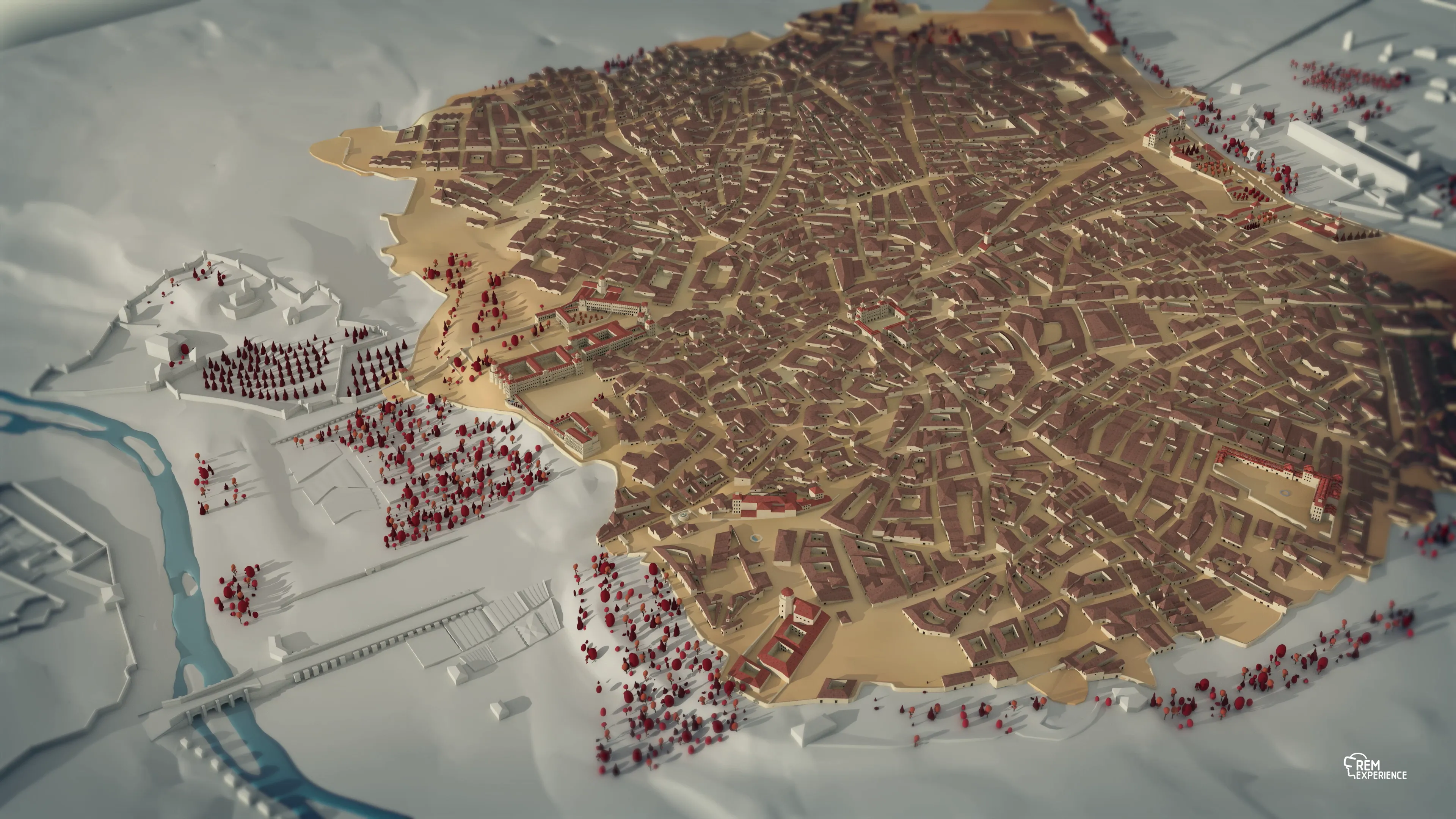
To accompany this journey visually, we developed digital reconstructions of Spanish cities, including Seville, shown at different stages of their historical development.
The goal was not simply a conventional architectural reconstruction. The project needed its own visual language that would work within the documentary narrative and let viewers quickly recognise a city, understand its layout and place it in a specific historical period.
That is why we worked from the initial concept art and visual direction stage, defining a specific look based on a three-dimensional representation resembling a historical scale model.
A different art concept to tell the story
Creating 3D content for television means adapting the level of detail, lighting, textures and composition to the language of the screen.
In this case we developed a style that deliberately moves away from hyperrealism in favour of a more conceptual, recognisable image. Buildings, streets and the main urban features are modelled and arranged as if the viewer were looking at an animated three-dimensional scale model of the city.
This treatment conveys a great deal of visual information without cluttering the screen and helps the reconstruction blend with the programme's narration.
The result combines concept art, 3D modelling, texturing, composition and architectural visualisation, creating digital settings designed specifically for television.
Showing how a city evolves through 3D
Virtualisation also makes it possible to show the same place at different moments in history.
Cities evolve together with society, culture and language. Being able to rebuild their layout digitally helps viewers understand the context in which certain historical and cultural events took place.
In episodes such as the one devoted to the Golden Age, the programme sets the story in key cities of the period such as Seville and Valladolid, as well as university towns like Alcalá and Salamanca.
Through 3D historical reconstruction, these places stop being mere names mentioned in the narration and take on a visual dimension that helps place viewers in the historical context.
3D modelling in the service of audiovisual production
Using 3D in documentaries makes it possible to depict things for which no images exist, rebuild lost settings and explain complex historical processes visually.
That is why the work starts long before the final modelling. You need to decide what information the scene should convey, select the most representative elements and develop an art direction consistent with the audiovisual format.
At REM Experience we combine visual concept design, 3D modelling, historical reconstruction and digital content production to create assets for television, documentaries, museums, cultural outreach and immersive experiences.
3D technology to communicate history and culture
Our work on La gran aventura de la lengua española shows how 3D modelling and historical visualisation can become storytelling tools that bring complex cultural content to a mass audience.
Technology makes it possible to rebuild cities, recover lost architecture and show how spaces have changed over time, while art design adapts all that information to the specific language of a television production.
The project thus brings together history, culture, audiovisual production, concept art and 3D reconstruction to help explain visually how a language evolved, along with the society that has spoken it for more than ten centuries.