
Projects
Salar Roman Villa · 3D reconstruction
We digitally recreated the Salar Roman Villa using high-precision 3D modelling, archaeological reconstruction and an interactive tour to visualise its architecture, mosaics, spaces and how it originally worked.
Virtual reconstruction of archaeological heritage goes beyond looking at the surviving remains to show what a historic space may have been like when it was inhabited. At REM Experience we developed the digital reconstruction of the Salar Roman Villa in Granada, one of the most outstanding Roman sites for the quality and richness of its mosaics.
The project takes the information produced by archaeological research at the site and turns it into a 3D virtual reconstruction of the complex, showing its architecture, decoration, the uses of its different spaces and the features of the landscape around the villa.
Archaeological reconstruction through 3D modelling
For the virtualisation we created a high-precision textured 3D model that digitally rebuilds the villa's different spaces.
The reconstruction does not just aim to show a complete building; it helps people interpret the archaeological remains that survive.
Walls, rooms, floors, ornamental features and structures come together in a coherent reconstruction based on what is known about the site and about Roman domestic architecture.
The mosaics of the Salar Roman Villa take centre stage: their extraordinary state of preservation and iconographic richness are among the site's greatest assets.
Understanding how a Roman villa worked
On top of the virtual model we built an interactive digital tour that helps users understand aspects of daily life that are hard to interpret just by looking at the remains today.
The experience reveals, for example, how the triclinium was used, one of the main spaces for entertaining and social life in Roman villas, and how other rooms were organised.
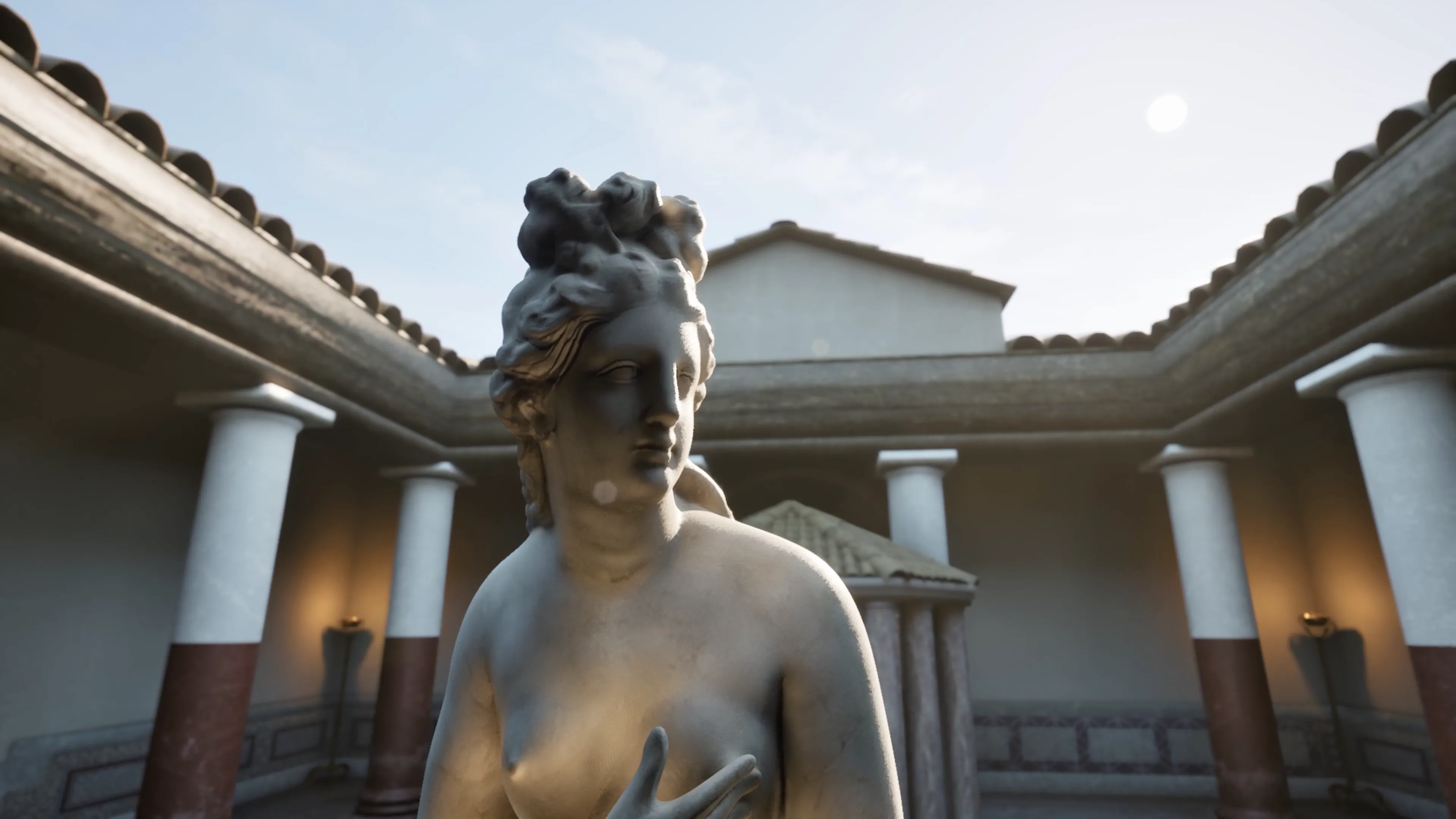
It also recreates how water flowed through the complex and its relationship with features such as the villa's fountain, showing how architecture, ornamentation and hydraulic systems were part of a single whole.
The reconstruction also shows the farmland around the villa, adding context about the relationship between the building, the land and the economic activity of Roman estates of this kind.
Incorporating new archaeological discoveries
One of the most interesting possibilities of virtual archaeology is that the digital model can evolve as research moves forward.
Excavations at Salar continue to yield information about new rooms and the villa's original layout.
The experience can incorporate these discoveries, including spaces whose function is still being studied and which might be, for example, an oecus, a reception room typical of Roman residences of a certain standing.
In this way, the virtual reconstruction also becomes a flexible tool for communicating how archaeological knowledge develops.
Digitising and visualising historical heritage
At REM Experience we develop heritage digitisation projects, 3D historical reconstructions, virtual archaeology, 3D modelling and immersive experiences for archaeological sites, museums and cultural spaces.
The Salar Roman Villa shows how technology can connect the remains that survive with what we can no longer see directly.
Combining archaeological research, 3D modelling and interactive visualisation makes it possible to digitally recover lost spaces and turn them into interpretation tools that help the public understand not only what the heritage looked like, but also how it was used and what life was like there almost two thousand years ago.